
Dear Gold Digger,
Most investors still view silver through an old lens.
They see coins. Bars. Jewelry. A smaller, more volatile cousin of gold.
That framework no longer explains the market.
Silver is still a monetary metal. But it is also something else now: a strategic industrial input with growing importance across the systems modern economies increasingly depend on.
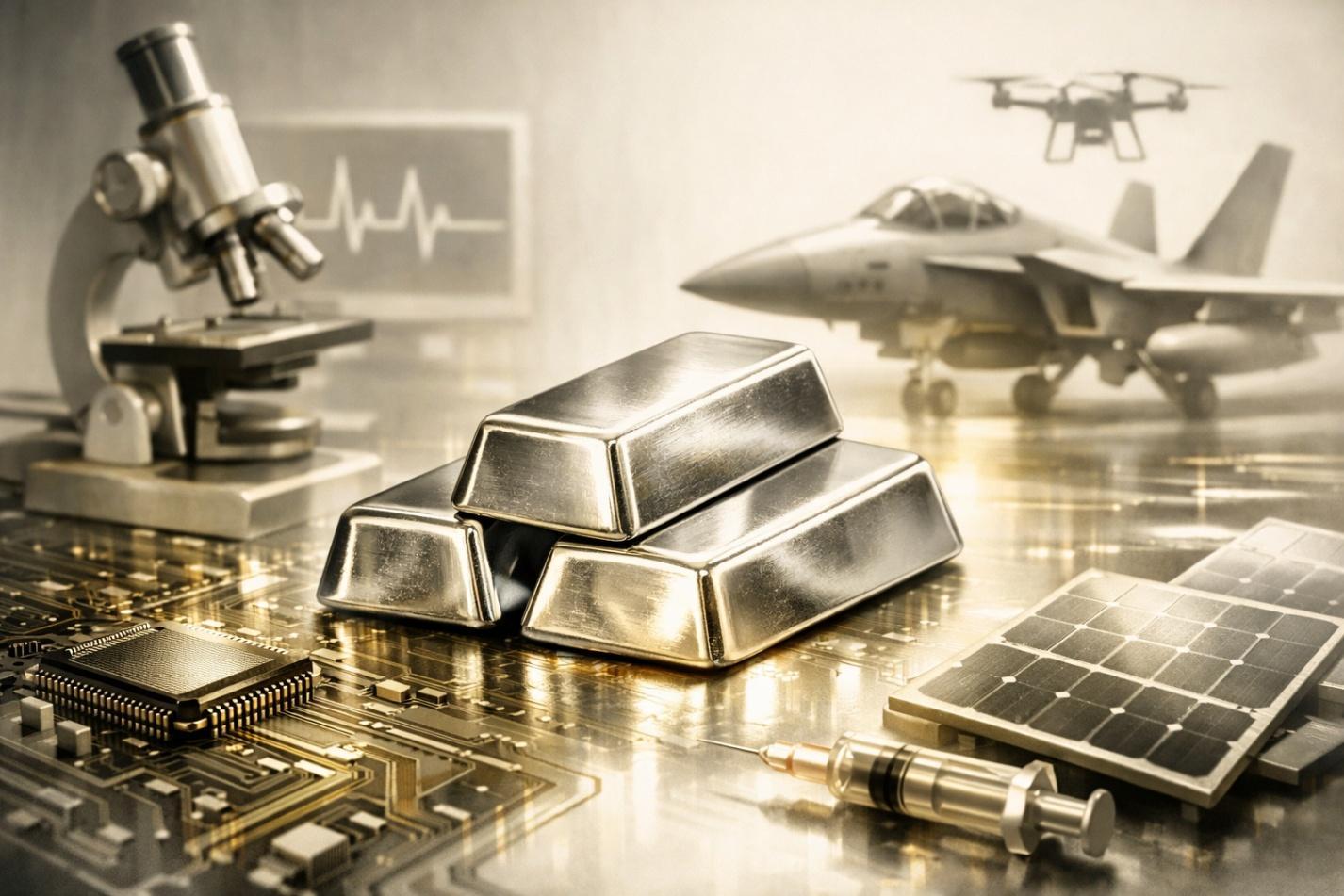
Healthcare. Electrification. AI infrastructure. Defense electronics. Grid expansion. Advanced manufacturing.
These are not marginal end markets. They are long-duration demand channels.
That distinction matters…
Because when a metal moves from optional use to functional necessity, the investment case begins to change.
Silver Is No Longer Riding on Monetary Demand Alone
For years, silver was easy to dismiss as a hybrid asset that never fully decided what it wanted to be.
Part precious metal. Part industrial commodity.
Too cyclical for conservative capital. Too volatile for most generalists.
Always interesting. Rarely understood.
But that view is becoming outdated…
Industrial demand has been doing more of the heavy lifting, and the trend is not random. It reflects a deeper shift in how silver is actually used in the real economy.
The market is increasingly being driven by applications where performance matters more than price and where substitution is more difficult than many assume.
That is a different backdrop than the one silver investors grew up with.
This is no longer just a reflation trade or a safe-haven side story. It is a supply-and-demand story tied to physical systems.
And those systems are expanding.
Why Silver Keeps Showing Up
Silver’s role is not mysterious. It is technical.
It has the highest electrical conductivity of any metal. It also ranks at the top in thermal conductivity and reflectivity.
When engineers need a material that moves electricity efficiently, handles heat well, resists corrosion, and performs reliably in demanding conditions, silver stays near the top of the list.
Yes, manufacturers try to reduce usage where they can. That is normal. But reduction is not replacement.
In critical applications, there is often a meaningful difference between using less silver and removing it altogether.
Investors who treat those two outcomes as the same are likely underestimating the resilience of real demand.
Markets are already signaling that silver is being pulled by utility, not just sentiment.
Healthcare: Quiet Demand, High Value
One of the least appreciated parts of the silver story is healthcare…
Silver’s antimicrobial properties have made it valuable in wound care, medical dressings, coatings, water purification, infection control, and a range of advanced biomedical applications.
That may not sound as exciting as AI or as visible as solar, but it matters for a different reason: these are uses where performance is central to the product itself.
Hospitals and medical suppliers do not choose inputs because they are fashionable. They choose them because they work.
That gives silver a durable role in a category where reliability carries more weight than commodity pricing.
It may not be the largest source of demand by volume, but it reinforces something more important: silver is not just being consumed. It is being relied upon.
That is the kind of demand that tends to persist.
AI Is Physical Before It Is Digital
The market talks about artificial intelligence as though it exists in software alone.
It does not.
AI runs on physical infrastructure…
Servers. Circuit boards. Connectors. Switches. Sensors. Power systems. Cooling systems. Data centers. Transmission equipment. Industrial automation. Edge devices. Networking hardware.
Every layer of that buildout depends on materials.
Silver is one of them.
This is where many investors miss the story. They hear “AI” and think only of software companies, chip designers, and cloud platforms.
But AI is also an electrical infrastructure story, and silver is embedded in the hardware behind that expansion.
That doesn’t mean AI will consume silver in the same public, headline-grabbing way solar has. It means something more subtle.
As digital infrastructure scales, silver demand becomes more deeply embedded in the architecture of the system itself.
This isn’t obvious yet—but it will be.
Defense Demand Carries a Different Kind of Weight
Defense is another category where silver’s role tends to be underappreciated.
In military and aerospace systems, the priority is rarely to find the cheapest possible material. The priority is reliability under stress.
Heat. Speed. Corrosion. Vibration. Mission-critical failure risk.
Those are not conditions where manufacturers casually downgrade performance to save a marginal amount on input costs.
Silver continues to appear in electronics, batteries, solders, bearings, coatings, and communications-related systems because it solves real engineering problems.
This matters even if defense is not the largest consumer by volume.
Not all ounces carry the same strategic weight.
Demand tied to national security, aerospace systems, and mission-critical hardware tends to be sticky.
It’s performance-first demand. And performance-first demand is harder to displace.
That adds another layer of structural support beneath the market.
Solar Still Matters—Even If It’s No Longer the Whole Story
Solar deserves mention, though not because it is new.
Most investors already know silver is used in photovoltaics. What matters now is not awareness. It’s scale.
Even where manufacturers work to reduce silver loading per cell, total deployment can still keep aggregate demand elevated.
That’s the larger point investors need to understand. Efficiency gains do not automatically weaken a commodity thesis when the underlying market is expanding aggressively enough.
In fact, attempts to thrift silver often tell you something important…
They tell you the metal matters.
Industries do not spend time and capital trying to reduce exposure to an input that is irrelevant. They do it because the input is essential enough to affect economics at scale.
Thrifting is not a sign of obsolescence. Often, it is a sign of dependence.
The Market Structure Has Changed
Put all of this together and the silver market looks different than it did a decade ago.
The old framework treated silver as a largely cyclical metal with occasional monetary upside.
Industrial demand would strengthen during favorable economic periods, then weaken when the cycle turned.
Investors could always collapse the story back into one simple line: silver follows growth, and sometimes it follows gold.
That is no longer enough.
Today, silver sits at the intersection of several structural buildouts at once.
Healthcare systems continue to rely on its antimicrobial properties.
Electrification and grid investment require conductivity.
Data infrastructure and AI expansion increase hardware intensity.
Defense systems continue to prioritize performance over cost minimization.
Solar remains an important source of pull on supply.
That’s how cyclical demand begins to evolve into structural demand.
And when that happens while supply remains constrained, repricing risk increases.
Not because a headline says so.
Because the physical market tightens first.
What Serious Investors Should Notice
None of this means silver moves in a straight line. Chances are it will not.
Silver remains volatile. Sentiment will overshoot.
Mining equities will exaggerate every move. And traders will continue to treat it like a momentum instrument.
That’s the nature of the space.
But long-term investors should notice what’s changing beneath the noise.
Silver is becoming harder to classify as a secondary precious metal with occasional industrial relevance.
It is increasingly a strategic material with monetary optionality attached.
That is a far better setup than most people realize.
It’s the monetary anchor. The reserve asset without counterparty risk. The metal central banks accumulate when confidence in paper systems begins to erode.
But silver is different…
Silver is where monetary history meets industrial necessity.
And when both sides of that equation begin to matter at once, the market typically moves before the narrative arrives.
The Bottom Line
Investors looking at silver only through the lens of inflation, retail coin demand, or gold’s shadow are likely looking at yesterday’s market.
The more important question is not whether silver is precious…
It’s whether the modern economy can keep scaling without it.
That’s the real story.
And it’s why silver may be moving out of the category of misunderstood metal and into the category of strategic asset.
Stay early. Stay sovereign. Stay on the right side of history.
To owning what’s real,

Jason Williams
Senior Investment Strategist, Gold World