
Something just happened in Washington that most people will scroll past…
And that’s exactly why it matters.
Because when policy moves quietly — when legislation is introduced without fanfare, without CNBC banners, without Wall Street pounding the table — that’s often when the biggest shifts are beginning beneath the surface.
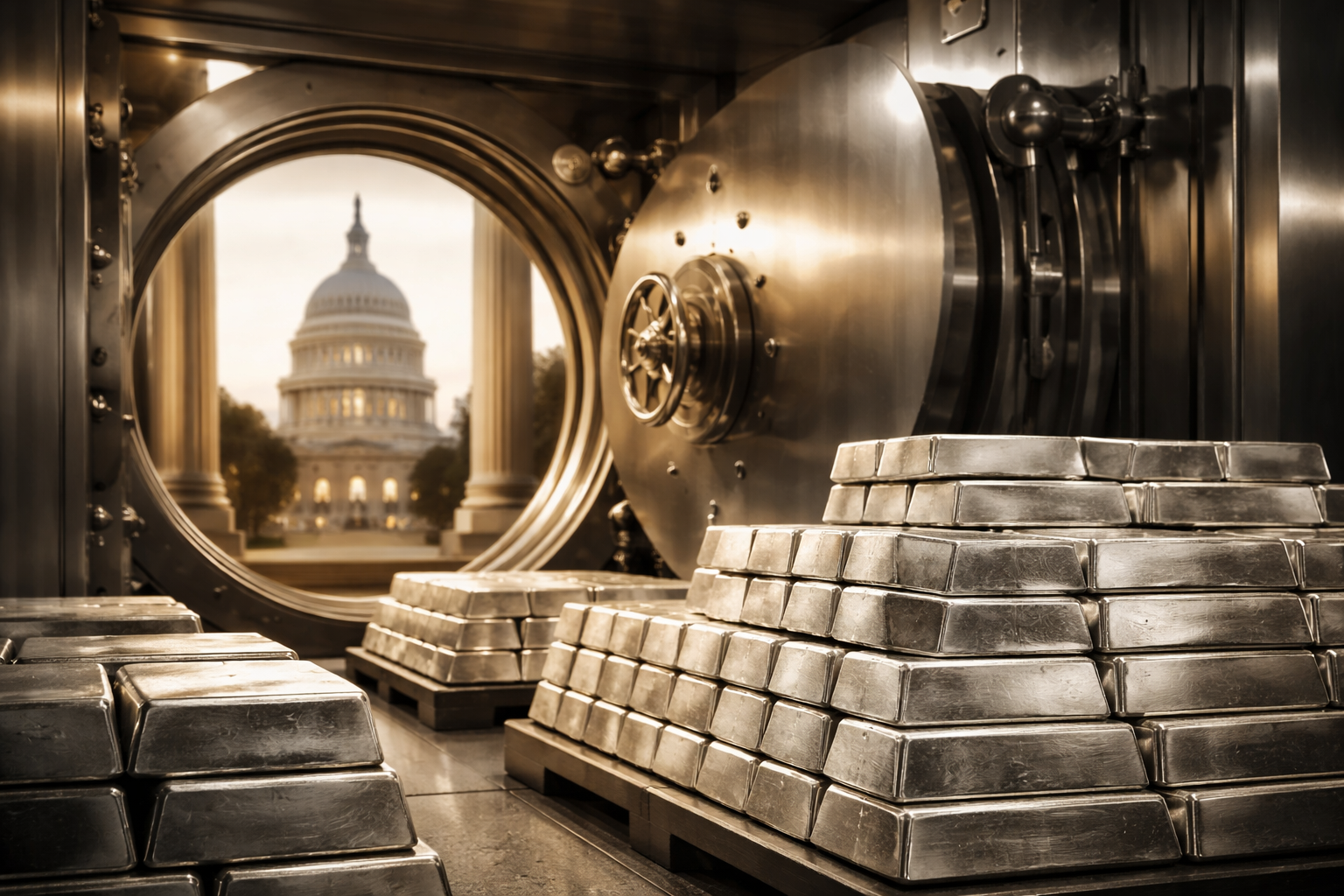
Lawmakers have introduced what’s now being called the SILVER Act — a piece of legislation designed to de-risk the U.S. precious metals market, strengthen domestic supply chains, and restore strategic control over one of the most overlooked assets in the entire financial system.
The SILVER in the SILVER Act stands for System Integrity through Licensed Vault Expansion and Resilience.
At first glance, it sounds technical. Bureaucratic. Almost boring.
It’s anything but.
Because what this really represents is something far bigger:
The U.S. government is waking up to the reality of the MoneyQuake.
Let’s step back for a moment — because if you’ve been reading Gold World, you already know this:
We are not living through a normal cycle.
We are living through a structural reset of how the world values real assets.
We’ve seen it in gold — central banks buying at record levels, repatriating reserves, hoarding physical metal like it’s oxygen.
We’ve seen it in infrastructure — vaults being built, storage facilities expanding, physical custody becoming strategic.
We’ve seen it in energy — supply tightening, geopolitical premiums rising, capital flowing into real-world throughput.
And we’ve seen it in industrial metals — copper, uranium, rare earths — all being quietly stockpiled by nations preparing for a more fragmented, resource-driven future.
But silver? Yes, silver.
Why Now?
Silver has been the anomaly.
Undervalued. Underappreciated. Under-discussed.
And yet, sitting at the exact intersection of everything that matters.
Earlier this year, China announced it was tightening control over silver exports starting January 1. On paper, it looks technical. In reality, it marks a quiet but consequential shift: silver is being upgraded from an ordinary industrial metal to a strategic resource, regulated much like rare earths.
That change has ripple effects across global supply chains, defense manufacturing, clean energy, and financial markets, especially in the United States and Europe.
Silver is not just a precious metal.
It is a monetary metal and an industrial necessity — all at once.
It is used in:
• Solar panels and renewable infrastructure
• AI systems and semiconductor fabrication
• Defense electronics and advanced weapons systems
• Electric vehicles and grid expansion
• Medical technology and antimicrobial applications
In other words…
Silver is not optional.
It is foundational.
And yet — despite all of this — the United States has allowed itself to become increasingly dependent on foreign supply chains for silver and other critical minerals.
Let that sink in.
At a time when:
• AI demand is exploding
• Energy systems are being rebuilt
• Defense technology is accelerating
• Global tensions are rising
The U.S. does not fully control its access to one of the most critical materials in that entire ecosystem.
That’s not just an economic vulnerability. That’s a national security risk. And this is exactly why the SILVER Act makes total sense right now.
Because what this legislation is really about is not price…
It’s about control.
It’s about ensuring that the United States has:
• Reliable access to domestic silver supply
• Reduced exposure to foreign disruptions
• A stable, transparent precious metals market
• Strategic reserves aligned with future demand
This is policy recognizing what markets have already begun to signal:
Physical metals are becoming too important to outsource.
Now here’s where it gets even more interesting.
Because this isn’t happening in isolation.
It fits perfectly into the broader trend we’ve already been tracking — the one we laid out in our earlier editorial:
The rise of physical storage infrastructure.
The hoarding of strategic materials.
The migration of capital into tangible assets.
The realization that wealth is moving out of abstractions… and back into matter.
What’s Happening in Casper, Wyoming?
Take a look at what’s happening in Casper, Wyoming — a place no one associates with global finance — becoming a hub for physical metals storage. A 70,000-square-foot fortress designed not for speculation, but for custody. For control. For permanence.
That wasn’t random. That was a signal. A signal that the world is preparing for scarcity. A signal that institutions expect physical assets to become more valuable, not less.
And now?
Washington is effectively confirming that signal with policy.
Because the SILVER Act is not just about stabilizing markets.
It’s about preparing for what comes next.
And what comes next is a world where:
• Supply chains are fragmented
• Resources are weaponized
• Nations prioritize self-sufficiency
• Physical assets underpin economic power
Let me put this as plainly as possible:
You cannot build the future without silver.
You cannot scale AI without it. You cannot electrify grids without it. You cannot produce advanced defense systems without it.
And you certainly cannot depend on fragile, geopolitically exposed supply chains to deliver it when tensions rise.
This is why silver is beginning to transition from a “commodity”…
Into a strategic asset.
Just like oil did in the 20th century. Just like rare earths are doing today. Just like gold has always been.
And once that transition happens?
Everything changes.
Because strategic assets are not priced the same way commodities are.
They are not valued based on short-term supply and demand curves.
They are valued based on:
• Security
• Availability
• Control
• Strategic necessity
Which means the repricing of silver…
May not just be cyclical.
It may be structural.
Now let’s connect this back to the MoneyQuake.
Because what we’re seeing here is the convergence of three powerful forces:
1) Monetary Instability
Debt levels are unsustainable. Currencies are being diluted. Confidence in fiat systems is eroding.
This drives demand for hard assets — gold, silver, real resources.
2) Industrial Explosion
AI. Energy. Electrification. Defense.
All of it requires physical inputs — and silver sits at the center of that web.
3) Policy Response
Governments are no longer ignoring these realities.
They are acting on them. Through legislation like the SILVER Act.
Through domestic production incentives. Through strategic stockpiling.
And when you get policy, demand, and scarcity all moving in the same direction…
You don’t get incremental change.
You get repricing.
Now here’s the part most investors will miss — just like they missed gold at $1,200… at $2,000… at $3,000…
They will wait for confirmation. They will wait for headlines. They will wait for the move to already happen.
But you and I both know how this works.
By the time it’s obvious…
It’s expensive.
The smart money — the sovereign money — the institutional money… Moves before the narrative. Before the media. Before the crowd.
And right now?
The signals are everywhere:
• Governments are hoarding metals
• Vaults are expanding globally
• Energy and industrial demand is surging
• Policy is shifting toward domestic control
• And silver is sitting right in the middle of it all
This is not a coincidence.
This is coordination.
Not in the conspiratorial sense…
But in the systemic sense.
A system adapting to a new reality.
And that reality is simple:
The future belongs to those who control physical resources.
Gold is the foundation.
Silver is the multiplier.
And policy — like the SILVER Act — is the confirmation. And if this MoneyQuake continues to unfold the way it already has…
Then silver won’t just follow gold.
It will accelerate beyond it.
Welcome to the Silver Awakening.
—Brian Hicks, Gold World