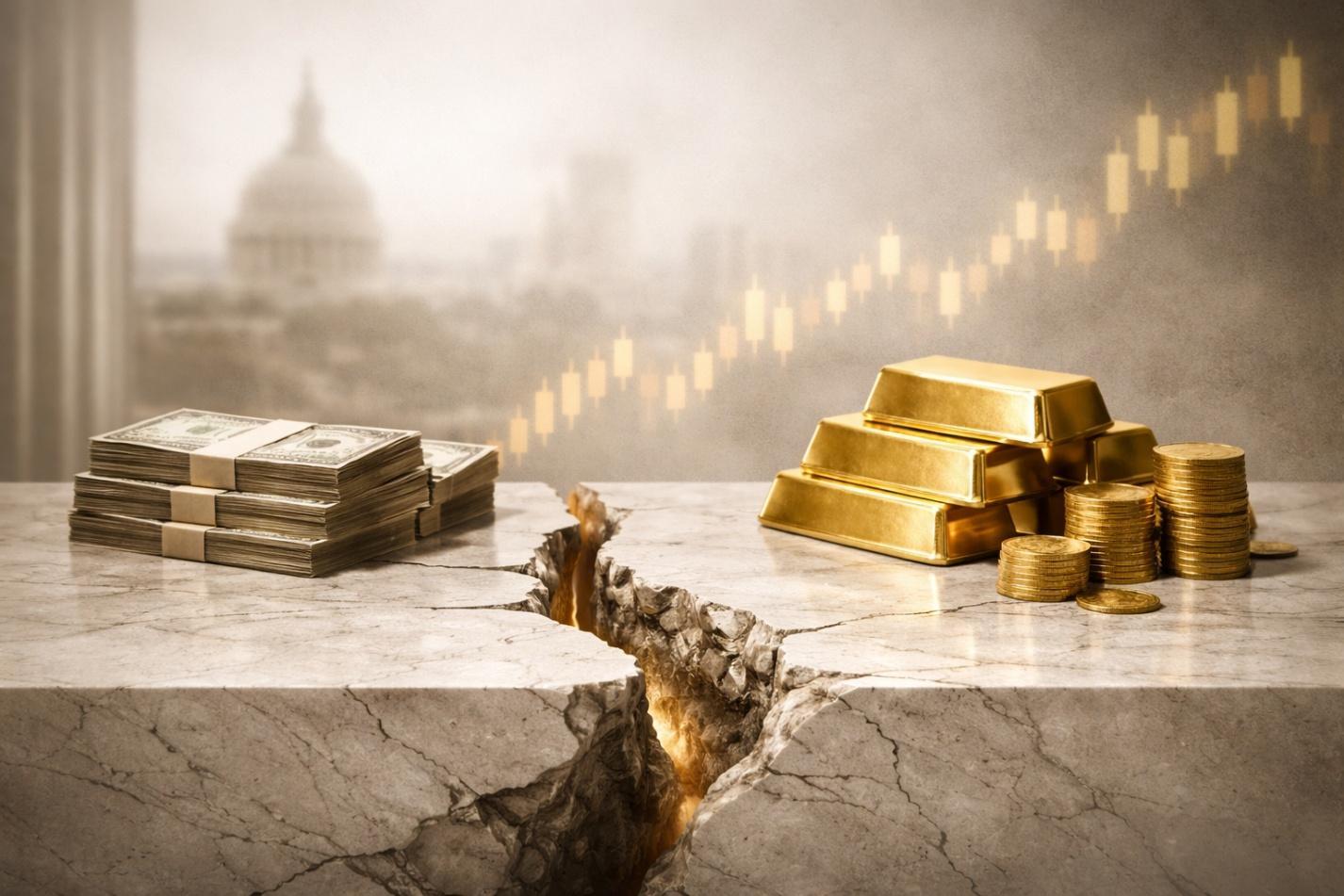

When war breaks out, markets don’t sit around and debate nuance. They lunge for whatever feels safest in the moment.
In this case, that first instinct was the U.S. dollar and short-duration cash…
Reuters reported that in early March, as the Iran conflict rattled markets, the dollar index posted its best day in seven months.
In the same stretch, U.S. money market funds pulled in tens of billions of dollars, and by March 20 total money market assets had swelled to roughly $7.8 trillion to $8.3 trillion.
That is not subtle positioning. That is institutional capital sprinting for shelter.
The First Trade Is Usually the Obvious One
That made sense at first…
Oil was ripping higher, geopolitical headlines were getting darker, and investors had every reason to assume that the cleanest immediate response was to buy cash, buy dollars, and ask questions later.
Reuters noted that this latest escalation has been especially tricky because the usual haven complex hasn’t behaved in the usual way…
Bonds have struggled because higher energy prices rekindled inflation fears.
Gold has wobbled because a stronger dollar and firmer yields have complicated the classic crisis playbook.
In other words, this wasn’t a neat “risk off means buy everything defensive” moment.
It was a “grab the most liquid thing in the room” moment.
That’s phase one.
But phase one doesn’t last forever…
History Says Panic Has a Shelf Life
One of the easiest mistakes investors make is assuming the opening move will also be the lasting move. But markets rarely work that way.
The first trade in a geopolitical shock is almost always emotional, mechanical, and crowded.
But the second trade is the one that matters more, because that’s where capital starts to think instead of just react.
That’s why it helps to compare today’s market action not just to recent Middle East flare-ups, but also to the early 2000s Iraq War.
Shorter shocks often create a reflexive dollar bid that can fade quickly once investors decide the event is containable.
But longer conflicts are different. They force the market to grapple with cost, duration, debt, inflation, and policy consequences.
That’s exactly what happened around Iraq…
Contemporary reporting from March 2003 showed the dollar was not enjoying some glorious and lasting wartime boom.
In fact, ABC reported that as the march toward war intensified, the U.S. dollar weakened slightly rather than acting like a runaway haven. That’s a crucial point…
A wider conflict may produce an initial fear trade, but once institutions realize they are dealing with a long, expensive military commitment, the conversation changes.
The question stops being, “Where can I hide today?” and becomes, “What does this do to deficits, energy prices, inflation, and the long-term value of financial assets?”
Reuters’ retrospective on the Iraq War underscores the long shadow those kinds of conflicts can cast, including massive fiscal costs and broader geopolitical consequences that continued to reverberate years later.
And that is the deeper lesson for investors…
Prolonged conflict can weaken the purity of the dollar trade because war is not just fear. It’s also spending, borrowing, distortions, and unintended consequences.
That matters today more than most people appreciate.
The Dollar Is Starting to Lose Its Momentum
Now let’s get to the signal that really matters…
The most interesting thing about today’s tape is not that the dollar surged when the conflict escalated. That was expected.
The interesting thing is that the dollar is no longer extending higher in a convincing way even as the news flow remains ugly.
Reuters reported on March 20 that the dollar was headed for roughly a 1.1% weekly loss despite the war continuing to expand and despite ongoing inflation fears tied to higher energy prices.
That is exactly the kind of behavior you watch for when the first haven trade starts to get tired.
This is how fatigue shows up…
The headlines remain negative. Oil stays elevated. Central banks sound nervous. Markets talk openly about stagflation. Yet the dollar can’t keep making new highs.
That’s not the all-clear. It’s something more useful than that…
It’s the first clue that the obvious trade may already be crowded and that institutional capital is beginning to think about where it goes next.
Reuters also noted that investors are now parking huge sums in money market funds earning around 3%–4%, but that this is, in effect, a waiting room.
Cash is a place to hide. It is not a place to compound wealth forever.
And once too much capital crowds into the waiting room, the next move tends to matter a lot.
When Capital Starts Looking for a New Home
If the dollar keeps failing to make fresh highs while the headlines worsen, the market is telling you something very important…
It’s telling you that investors may already have enough cash. They may already be fully aware of the risks. They may already have expressed that fear trade.
At that point, incremental fear stops generating the same response. And that’s when the next rotation begins to brew.
Now, I think that coming capital shift has two sides…
One side is tech and growth. These areas tend to get punished when yields rise, when inflation fears revive, and when traders rush toward cash.
But if the dollar stalls and the market begins to believe the panic phase is maturing, some of the most beaten-down growth assets can catch a bid simply because the liquidation pressure starts to ease.
This doesn’t require perfect peace. It only requires the fear trade to stop intensifying.
The other side, and the side I care more about here, is precious metals, miners, and selected materials.
These groups have been whipsawed by the bizarre reality of this market, where war has not immediately produced a smooth, textbook rally in all hard assets.
Gold and silver have faced pressure from the stronger dollar and rising yields.
Some materials names have been hit even harder as markets reassessed the inflationary consequences of the conflict and the possibility of tighter-for-longer policy.
Reuters noted that investors have favored cash over both bonds and gold in the current phase because money market funds offer yield while avoiding duration risk and some of the volatility in metals.
But here’s the thing…
That kind of selling can create opportunity precisely because it’s rooted in short-term positioning rather than a collapse in the long-term case for hard assets.
Gold Still Looks Like the Main Event
If we’re going to focus this trade, we should focus it where the macro logic is strongest. For me, that’s still gold…
Gold hasn’t been the clean winner in this first phase because the market got pulled toward dollars instead. Fine. That happens.
But if the conflict proves persistent, expensive, and inflationary, the longer-run argument for gold actually gets stronger, not weaker…
A prolonged war in a critical energy-producing region isn’t just a fear story.
It is a debt story. It is a deficit story. It is a currency-confidence story. It is an energy-cost story.
And gold tends to shine brightest when investors finally remember that governments finance these kinds of adventures the old-fashioned way: by piling more obligations onto already absurd balance sheets.
This is why I’m more interested in gold than silver here, even though silver may eventually deliver sharper percentage moves if the trade broadens.
Gold is the cleaner macro expression. Gold sits at the intersection of monetary anxiety, fiscal skepticism, and geopolitical stress.
It doesn’t need the war to end. It doesn’t even need peace talks. It just needs the market to conclude that the first answer, buying dollars and sitting in cash, is no longer enough.
Once investors begin to make that mental shift, gold is a natural next destination.
And from there, the miners and broader materials space can follow.
Not all of them, of course. This isn’t a call to buy every shiny thing with a ticker symbol.
But if the dollar rolls over, or even just stalls while risk assets stabilize, then gold miners in particular could start to look very interesting because they have spent this phase absorbing the same pressure that hit the metal itself.
If the macro narrative rotates from “I need cash right now” to “I need protection from what comes after this,” gold becomes much harder to ignore.
The Invitation May Come Before the Headlines Improve
This is where a lot of people get tripped up…
They wait for the headlines to improve before they act. But markets don’t reward that kind of obedience very often.
The real opportunity usually appears when the headlines are still awful but the price action starts to diverge from them. That’s what we’re watching for now…
If the Iran war continues to expand, oil stays elevated, central banks remain uneasy, yet the dollar still fails to make meaningful new highs, that’s not noise.
That’s information…
And it suggests the first wave of fear has already been priced in and the market is preparing for the next allocation decision.
For intrepid investors, that means it may make sense to begin making those allocations now, before the crowd gets comfortable.
Not recklessly. Not all at once…
But thoughtfully and deliberately, with an eye toward the areas that have absorbed the most punishment during this fear-driven dash into dollars and cash.
For lower-risk investors, the signal is even simpler: Watch the dollar.
If more negative headlines arrive and the greenback still cannot make fresh highs, take that as your invitation.
That doesn’t guarantee an immediate straight-line rally in gold, miners, materials, or even growth stocks. Markets are never that polite.
But it does tell you that the old safe-haven trade is losing its power, and once that happens, capital rarely sits still for long.
The Crowd Will Always Arrive Late
The crowd loves clarity. Unfortunately, clarity is usually expensive.
By the time everyone agrees that the dollar trade has run its course, by the time the headlines soften, by the time gold is clearly back in favor and the miners are already moving, the easiest money will likely be gone.
That’s the price of emotional comfort. It makes you feel smart while quietly ensuring you perform like the market instead of ahead of it.
That’s why moments like this matter…
We aren’t trying to predict every headline or guess the exact day of a reversal.
We’re trying to recognize when a trade that made perfect sense in phase one is beginning to lose force in phase two.
The Iraq War teaches us that long conflicts can drain the purity from a simple dollar-safe-haven thesis.
Today’s tape suggests we may be seeing a version of that process unfold in real time.
So be bold while others are fearful.
Start thinking now about where the next wave of capital is likely to go, not where the last one already went.
Because if you wait for unanimous confirmation, you’ll always be the market. And if you’re always the market, you’ll never beat it.
Stay early. Stay sovereign. Stay on the right side of history.
To owning what’s real,

Jason Williams
Senior Investment Strategist, Gold World