

Gold to a million isn’t some bold forecast.
It is a monetary outcome… an inevitability.
The number sounds extreme only because we’re measuring it in a currency that’s being diluted in real time.
Gold doesn’t need mania. It doesn’t need panic. It doesn’t need headlines.
It just needs math.
And the math is already underway.
The Repricing Has Already Begun
When fiat systems stretch beyond productive capacity, price becomes arithmetic. Not opinion.
Markets are already signaling strain in sovereign debt, currency credibility, and fiscal discipline.
The world we live in is saturated with promises. Very little is anchored to something real.
But gold doesn’t compete with technology. It competes with credibility.
And credibility is something we can all probably agree is in structural decline.
The Path to a Million Is Monetary, Not Speculative
Here’s the headline everyone is failing to print: million-dollar gold doesn’t require mania.
It just requires math…
Global debt continues compounding faster than productive output.
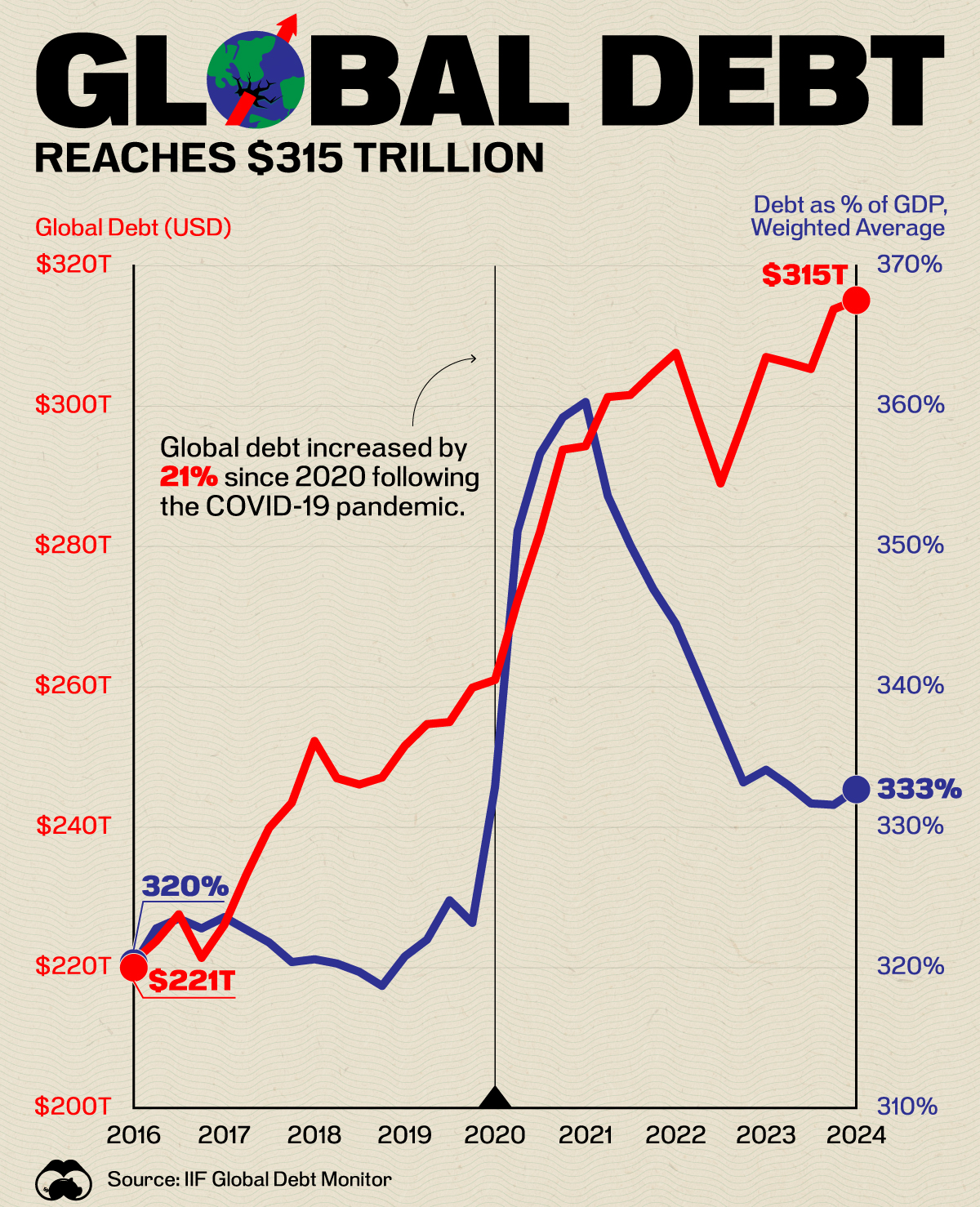
Monetary authorities respond the only way they can — by expanding liquidity in the form of rate cuts and endless easing to preserve system stability.
That liquidity doesn’t disappear. It accumulates in hard assets.
History suggests this is how monetary resets unfold. Quietly at first. Then suddenly.
Gold doesn’t need hyperinflation. It only needs sustained dilution.
In prior monetary cycles, gold re-priced to reflect systemic imbalance. And the market moved before the narrative arrived.
This time is no different.
If fiat supply expands multiples from here — and structural deficits suggest it will — gold reprices accordingly.
The number one million is simply a function of how far paper must fall to restore equilibrium.
This isn’t obvious yet—but it will be.
Over decades, monetary resets re-anchor value to something finite. And gold has performed that function across empires, ideologies, and regimes.
It doesn’t depend on policy. It survives it.
And history suggests that when debt cycles crest, hard assets don’t rise gradually. They reprice.
Quietly at first. Then decisively.
The Constraint Isn’t Demand. It’s Access.
Here’s what most investors miss:
There isn’t nearly as much investable gold as the financial system would require in a true collateral reset.
Above-ground supply is finite. New discoveries are declining. Extraction is expensive, slow, and increasingly political.
Mining just isn’t scalable at the pace monetary expansion demands.
So the next phase of gold’s ascent won’t just be about price.
It will be about unlocking supply — intelligently.
Where NatGold Enters the Equation
This is where NatGold becomes pivotal.
NatGold isn’t a mining company. It’s not a traditional stock. It’s an asset structure built around verified, in-ground gold deposits that remain unmined.
Instead of extracting metal through capital-intensive and environmentally disruptive processes, NatGold monetizes certified reserves while the gold stays in the ground.
Geological scarcity becomes financial scarcity.
The metal isn’t disturbed. But its value becomes accessible.
In a world that’s digitized nearly every financial instrument, gold’s constraint hasn’t been belief. It’s been infrastructure.
Large pools of capital can’t simply warehouse physical bars at scale without friction.
NatGold addresses that friction.
It transforms proven reserves into investable, transferable assets without waiting years for permitting, development, and production cycles.
This isn’t speculation. It’s structural modernization of a 5,000-year monetary anchor.
If gold is repricing higher — and central bank behavior suggests it is — the system will require scalable, compliant ways to represent ownership of real reserves.
NatGold aligns directly with that need.
Capital is quietly positioning around assets that combine physical backing with financial efficiency.
Scarcity Reasserts Itself
The deeper issue isn’t whether gold “should” rise.
It’s whether fiat systems can sustain perpetual expansion without consequence.
History suggests they can’t.
Every monetary regime eventually confronts its own excess. When it does, capital seeks neutrality — an asset outside political discretion.
Gold has always filled that role.
What’s different now is scale. Global capital is larger, faster, and more interconnected than ever.
If gold is to absorb the magnitude of reallocation that systemic stress would trigger, infrastructure like NatGold becomes essential.
It doesn’t replace bullion. It reinforces gold’s monetary role.
The constraint shifts from supply discovery to supply representation.
And that changes velocity.
The Million-Dollar Reality
A million-dollar gold price won’t feel sensational when it arrives… It’ll feel mechanical.
It’ll reflect decades of accumulated imbalance finally expressed through one honest number.
Those positioned in scarce, sovereign assets won’t need to justify it. They’ll understand that gold did what it’s always done — reprice against deteriorating currency credibility.
NatGold represents an evolution in how that scarcity is accessed.
Gold remains finite. Currency remains elastic.
Over time, elastic systems stretch too far.
Hard assets don’t stretch. They re-anchor.
This is positioning, not speculation.
Stay early. Stay sovereign. And stay on the right side of history.
To owning what’s real,

Jason Williams
Senior Investment Strategist, Gold World