
Greetings, Gold Digger.
When people think about military power, they usually think about hardware…
Missiles. Drones. Ships. Jets. Contractors. Budgets.
They think about the finished product. They usually don’t think about the metals inside it.
But they should…
Because the real constraint in a military buildup isn’t always money. It’s material.
Yes, the ceasefire is still in place. But it’s fragile. The first round of negotiations didn’t deliver a breakthrough, and a second round is already being prepared.
So this isn’t resolution. It’s an intermission.
And intermissions have a way of exposing what the system actually depends on…
Modern conflict doesn’t just burn through munitions. It burns through inventories, replacement cycles, and industrial inputs.
And it reveals how much of national security still rests on things that have to be dug out of the ground, refined, processed, shipped, and fabricated.
That’s the real story here.
Because you can approve spending overnight. But you can’t approve geology.
The Arsenal Doesn’t Start in a Factory
Washington can authorize billions. The Pentagon can place orders. Defense contractors can talk about ramping production…
But none of that changes the physical chain underneath the system.
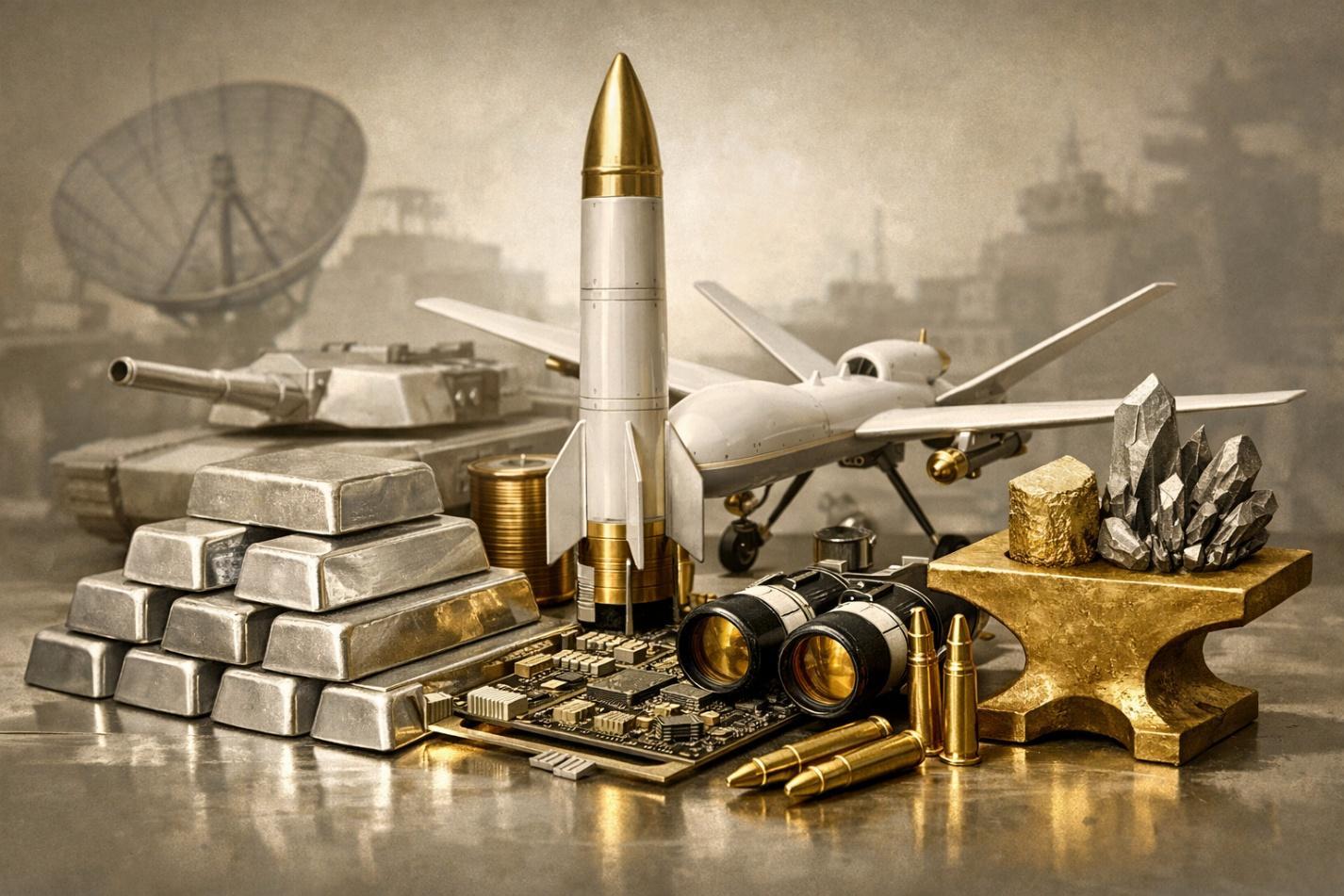
A missile isn’t just a weapons platform. It’s copper. Aluminum. Nickel. Titanium. Rare earths. Graphite. Gallium. Tungsten. Antimony.
A drone is the same story.
So is a radar array.
So is an interceptor.
So is the guidance system that makes the whole machine work.
But most investors tend to look at the visible end of the chain. They look at the contractor. The contract. The headline. The ceremony.
But the real bottleneck usually sits further upstream.
In the mine. In the refinery. In the processor…
In the part of the chain that can’t be rushed just because policymakers suddenly feel urgency.
And that’s where the market is still underestimating the story.
Base Metals Still Run the Machine
The flashy narrative usually goes to rare minerals. But no arsenal gets rebuilt without the old industrial metals doing the heavy lifting.
Copper is the obvious starting point…
It runs through wiring, motors, communications systems, electronics, power infrastructure, and virtually every layer of modern military hardware.
It isn’t exotic. And that’s precisely the point.
A metal doesn’t need to sound rare to become strategically scarce. It just needs demand to rise faster than reliable supply can respond.
The same goes for aluminum, steel, zinc, and lead.
None of them are fashionable. But all of them matter…
Because wars aren’t sustained by glamour. They’re sustained by volume, durability, and industrial throughput.
That’s the part retail investors often miss because everybody wants the dramatic story. The marketable bottleneck. The obscure mineral with the perfect narrative.
Meanwhile, the real industrial backbone is still built on enormous quantities of basic material.
Take that away, and everything stops.
Tungsten and Antimony Are What Scarcity Looks Like in Practice
Then you get to the smaller materials that suddenly stop looking small.
Tungsten is one of them and it matters because it’s both a battlefield metal and a factory metal.
It shows up in military applications, but it also matters in tooling, machining, and the industrial processes required to build hard systems in the first place.
That dual role gives it leverage.
It helps make the arsenal. And it helps fill the arsenal.
And antimony may be even more important…
It doesn’t get much public attention, but it has direct relevance to ammunition and munitions supply chains.
And U.S. dependence in that area is exactly the kind of weakness that looks tolerable during calm periods and dangerous the moment geopolitical stress starts rising.
That’s how strategic materials work…
They’re ignored right up until they aren’t. Then suddenly they matter all at once.
Markets are already signaling that shift. And governments are starting to treat these inputs less like commodities and more like security assets.
That changes how capital should view them.
The Electronic Battlefield Has Its Own Metals
Not every vulnerability is visible in a shell casing or a missile body, though. Some are buried in the electronics.
And that’s where rare earths and gallium come in…
Modern military systems rely on advanced sensing, communications, guidance, radar, magnets, wafers, and semiconductor materials that most investors never think about until supply is interrupted.
But that’s exactly the point.
The arsenal of the future isn’t just steel-intensive. It’s electronics-intensive.
And once you understand that, the supply chain story gets bigger.
This isn’t just about replenishing what was used…
It’s about securing the materials required to build the next generation of systems in a world where access can no longer be taken for granted.
That’s a very different framework from the one markets used during the era of cheap capital and global complacency.
And Yes, Silver Belongs in This Conversation
This is where the precious metals angle comes in…
Gold, of course, is the monetary anchor. It’s the asset investors return to when trust in policy, currency, and political management starts to erode.
But silver is different… Silver carries monetary DNA too. But unlike gold, it also sits inside the industrial system in a much more direct way.
And that’s what makes it so interesting here.
Silver matters in conductivity. In electronics. In contacts. In switches. In brazing alloys. In solar infrastructure.
In advanced industrial applications where efficiency and performance still matter.
So, silver doesn’t just benefit from monetary instability.
It also benefits when the physical economy starts demanding more from the same pool of real materials.
That gives it a different kind of optionality.
Gold is the cleaner monetary metal. Silver is the hybrid.
Part monetary hedge. Part industrial input…
Part hard-asset expression of a world that’s being pushed toward more electrification, more militarization, more strategic redundancy, and more monetary strain all at once.
That combination matters because if governments are forced to spend more, stockpile more, secure more, and print more, silver doesn’t sit outside that process.
It sits right in the middle of it.
This still isn’t obvious to most of the market. But it will be.
The Bigger Repricing Has Already Started
The ceasefire may continue. Or it may fail…
That matters tactically. But strategically, the deeper signal is already here.
Conflict has exposed the difference between financial capacity and physical capacity.
The U.S. can still allocate capital quickly. But what it still can’t do quickly is build a secure pipeline for the materials that modern power depends on.
That’s the gap. And capital is quietly positioning around it.
This is why the real opportunity isn’t about chasing yesterday’s missile headline. It’s about recognizing the larger repricing underneath it.
A repricing of upstream control. A repricing of scarcity. A repricing of hard assets over soft assumptions.
That includes industrial metals. That includes strategic materials. And yes, it includes precious metals too.
Gold for monetary protection. Silver for monetary leverage and industrial relevance.
The market usually notices these shifts late. But by then, the narrative feels obvious and the easy positioning is gone.
For now, this still sits in that quieter phase — where the physical world is changing first, and the consensus hasn’t fully caught up.
That’s usually where the best opportunities live.
Stay early. Stay sovereign. Stay on the right side of history.
To owning what’s real,

Jason Williams
Senior Investment Strategist, Gold World