The $2 Trillion Bailout
Let’s review the laundry list of wheelings and dealings between Uncle Sam and big business just in the past few months and the cost to US taxpayers like you and me:
- The Bear Stearns takeover by JP Morgan, which was midwifed by the federal government: $29 Billion
- Special liquidity programs sponsored by the Federal Reserve, including the Term Securities Lending Facility and Term Auction Facility: $200 Billion
- The Federal Housing Administration’s scheme to refinance defaulting mortgages into new, reduced-principal loans with a federal guarantee: $300 Billion
- The bailout of Fannie Mae and Freddie Mac: $200 Billion
- The bailout of American International Group: $85 Billion
- Repayments to JP Morgan for providing financing to underpin trades with bankrupt investment bank Lehman Brothers: $87 Billion
- The insurance program for money market funds: Up to $50 Billion
- Direct purchases of mortgage-backed securities by the US Treasury: $10 Billion
- Injection of cash into global credit markets by the Federal Reserve: $300 Billion
- Low-cost loans to help hard-pressed carmakers: $25 Billion
Add in the proposed $700 Billion rescue plan to buy back bad debt from the banks and we’re looking at nearly $2 Trillion!
That’s 10 times what the savings and loan crisis of the 1980s and 1990s cost taxpayers!
And here’s the kicker: All this still might not fix the problem! In fact, it probably won’t. What that means is the US government may come knocking on the American taxpayer’s door again in the near future for even more bailout money…a lot more.
The tsunami of cash gushing into the system may help boost liquidity in the short-term. But it won’t take long to will cripple the US dollar.
The U.S. Dollar Vs. Gold
The US dollar has recently broken its short-term uptrend. The US Dollar Index, a measure of the value of the greenback relative to a basket of six foreign currencies, has lost as much as 5.6% in the past two weeks.
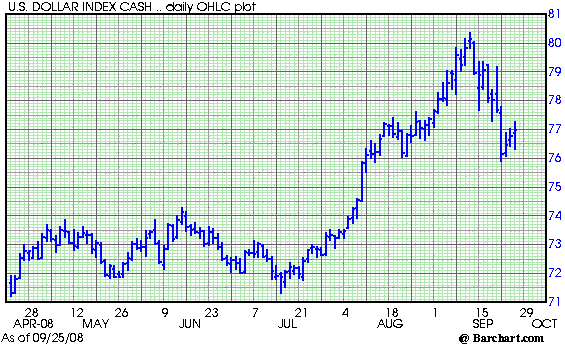
And if this crisis gets worse-which it probably will-and the US Treasury continues to open the floodgates on the money supply, all bets are off. The US dollar will likely lose most of it’s current value and maybe collapse.
And that’s exactly why you need to own gold right now.We saw gold prices get crushed over the past several weeks. And this came despite solid bullish fundamentals like an estimated 2% decline in global gold production for this year and the lowest sales of gold by the central banks since 1985.
The smart money is still betting on big moves in gold prices. Remember, we’re still in a gold bull market that I expect will take prices well past $2,000 an ounce.
Without a doubt-and more than ever before-this is one of those time when you want to have some physical gold and silver on hand.
The troubles for markets aren’t over…not by a long shot. If you don’t have gold in your portfolio, consider adding some now.
Good Investing,

Luke Burgess
Editor, Gold World