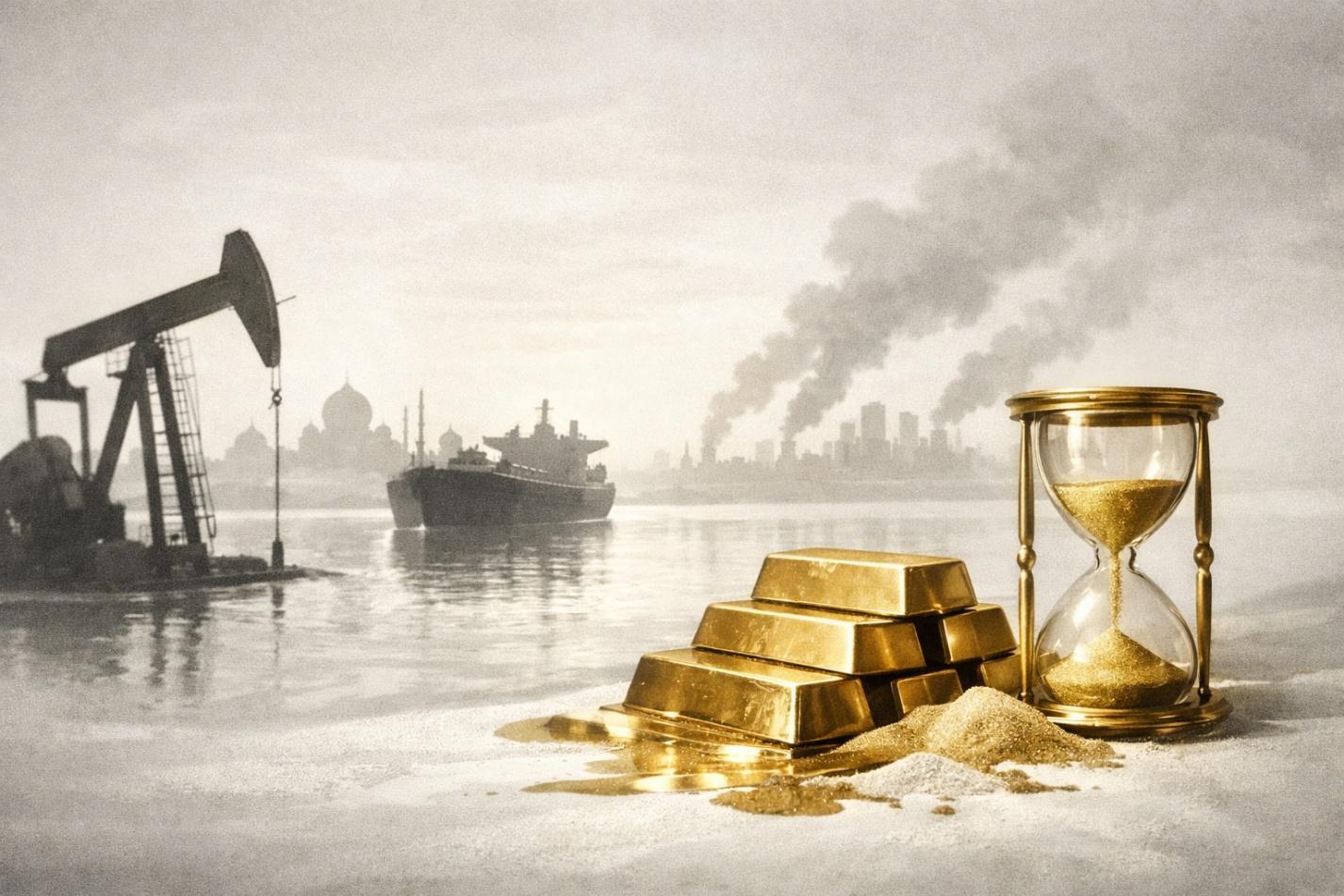

The most powerful gold bull markets rarely begin with gold itself.
They begin with energy…
Energy shocks raise costs. Rising costs create inflation. Inflation exposes weaknesses inside the monetary system.
And that’s when gold usually enters the story.
History has shown this pattern before.
The 1970s… The early 2000s…
And now, markets may be witnessing the early stage of something similar again.
When Energy Repriced the Global System
The 1970s began with a monetary shift.
In 1971, the United States ended the Bretton Woods system, severing the final link between the dollar and gold.
And for the first time in decades, gold was allowed to trade freely in global markets.
Then the oil crisis arrived…
In 1973, OPEC restricted oil exports to Western nations. Energy prices surged. Fuel shortages appeared across the United States. Inflation spread across the global economy.
Energy had suddenly become the dominant economic force.
But energy shocks don’t stay contained…
Higher fuel costs raise transportation prices. Transportation costs raise the price of goods. Food prices begin climbing. Inflation moves through the system like a rising tide.
Governments respond with spending. Central banks struggle to contain price pressure.
Confidence in currency stability begins to weaken.
Gold tends to notice.
Between 1971 and 1980, gold rose from roughly $35 per ounce to more than $800.
The move didn’t happen overnight.
But the forces behind it were unmistakable.
Energy disruption.
Inflation pressure.
Monetary instability.
Together, they defined the decade.
A Different War, a Familiar Pattern
A similar pattern appeared three decades later…
After the attacks of September 11, the United States entered a prolonged period of military engagement in the Middle East.
The invasion of Iraq in 2003 once again placed global attention on a region central to the world’s energy supply.
Oil markets responded gradually.
Energy prices trended higher throughout the decade. Global demand accelerated the pressure.
Gold began rising alongside it.
In the early 2000s, gold traded near $300 per ounce.
By 2011 it approached $1,900.
But the move didn’t begin immediately.
Gold spent long stretches consolidating during the early stages of the conflict. At times, the metal appeared disconnected from the geopolitical backdrop.
That’s normal…
Markets tend to react first to liquidity.
The deeper macro consequences take longer to unfold.
Energy costs rise. Inflation begins creeping higher. Government spending expands.
Only then do investors begin reconsidering the stability of the financial system itself.
And that’s when capital typically starts migrating toward hard assets.
Energy Shocks Change the Monetary Conversation
Energy disruptions rarely remain confined to energy markets.
They alter the monetary landscape.
When oil prices surge, inflation tends to follow. Governments feel pressure to cushion households from rising costs. Fiscal spending expands. Deficits grow.
Central banks face increasingly difficult tradeoffs…
Raise rates too aggressively and economic growth stalls.
Ease policy too quickly and inflation accelerates.
Neither outcome inspires long-term confidence in fiat currencies.
Gold historically performs well in that environment.
Not because of daily headlines…
But because it sits outside the policy framework attempting to manage those pressures.
Energy shocks introduce variables policymakers cannot easily control.
And that reality tends to favor assets that operate outside the system.
Why the Early Stage Often Feels Quiet
Investors often expect immediate confirmation during geopolitical crises.
War breaks out. → Gold explodes higher.
But reality tends to be more subtle…
The earliest stage of geopolitical shocks is usually defined by uncertainty.
Investors move toward liquidity. Currency markets adjust. Portfolio positioning shifts.
Only later do the economic consequences begin spreading through the system.
Energy markets tighten. Inflation data begins rising. Government spending accelerates.
Then markets start re-evaluating the long-term stability of the monetary system.
That’s when hard assets typically begin attracting attention.
That sequence takes time. But once it begins, it rarely resolves quickly.
The Pattern Quietly Reappearing
The tension developing today sits near one of the most important energy corridors in the world.
Roughly one-fifth of global seaborne oil passes through the Strait of Hormuz.
Even the possibility of disruption can ripple across the global economy.
Energy traders understand this immediately.
Financial markets often take longer to connect the implications.
That delay is where larger cycles sometimes begin.
History rarely repeats perfectly.
But energy shocks have a habit of exposing weaknesses already present in the financial system.
And when that happens, capital eventually begins searching for assets that exist outside the system itself.
Before the Narrative Becomes Obvious
Markets are still digesting the geopolitical developments unfolding across the Middle East.
The long-term consequences aren’t yet clear.
They rarely are in the early phase of events like this.
But history offers a useful framework…
When energy disruptions intersect with geopolitical instability, the ripple effects tend to extend far beyond the original headlines.
The 1970s demonstrated that. So did the early 2000s.
Gold’s most powerful advances during those periods didn’t begin on the first day of conflict.
They began as the economic consequences slowly reshaped the monetary system.
That process is rarely dramatic in the beginning… It unfolds quietly.
Which is why periods like this tend to reward patience.
Not urgency.
Because the investors who benefit most from the next phase are usually the ones who positioned themselves before the story became obvious.
Stay early. Stay sovereign. Stay on the right side of history.
To owning what’s real,

Jason Williams
Senior Investment Strategist, Gold World