

Dear Gold Digger,
Let’s go back exactly five years. September 23, 2021.
You’ve got $10,000 you want to put to work, and three doors in front of you.
Door No. 1 is bitcoin. It closed that day at $44,893 on Coinbase, and everybody on the internet told you it was going to $100,000 by Christmas.
Door No. 2 is the S&P 500. It closed at 4,449. Rates were pinned at zero, “there is no alternative” was the phrase of the year, and your brother-in-law was a stock-picking genius.
Door No. 3 is gold. It traded around $1,746 an ounce. It was down on the year. The financial press called it a pet rock, and the smart money on Twitter called it a boomer trade that bitcoin had already replaced.
You know which door the crowd picked…
Here’s what was behind each one as of yesterday’s close.
The Five-Year Scoreboard
I pulled the numbers from the St. Louis Fed’s database and the spot market so nobody can accuse me of cherry-picking.
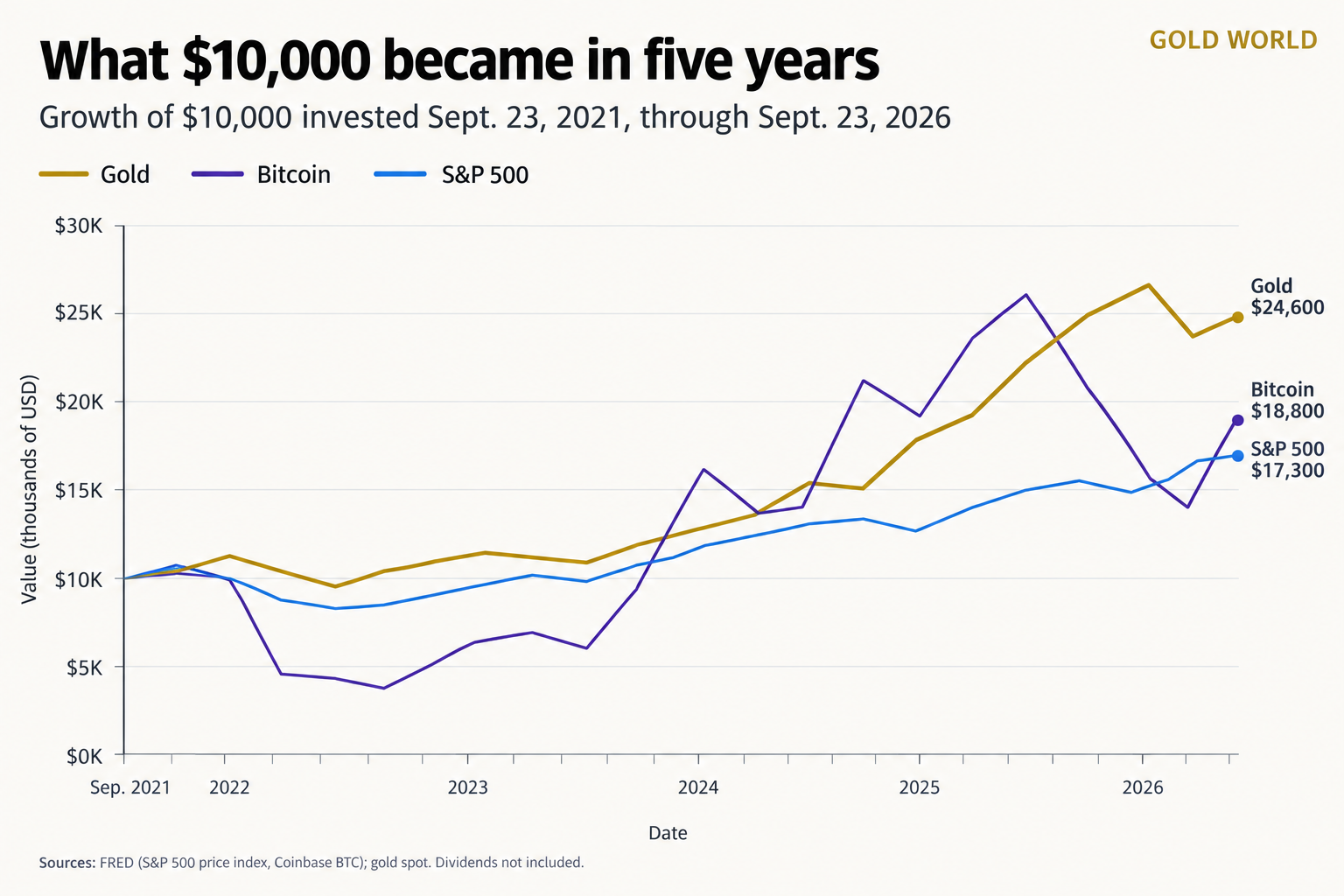
Bitcoin: $44,893 then. $84,453 yesterday. Up about 88%. Your $10,000 is now roughly $18,800.
S&P 500: 4,449 then. 7,706 yesterday. Up about 73%. Your $10,000 is now roughly $17,300.
Gold: $1,746 then. About $4,286 yesterday. Up about 145%. Your $10,000 is now roughly $24,600.
Read the order of finish again. The pet rock came in first, and it wasn’t close.
Annualized, that’s about 20% a year for gold, 13.5% for bitcoin, and 11.6% for the S&P. Reinvest the dividends and the S&P picks up several more points, but it still finishes last.
Brian ran the twelve-month version of this on Monday. Gold up 20%, bitcoin down 30%. A fair response to one year of data is “sure, but that’s one year.” So I wanted the longer tape. Five years covers a zero-rate mania, a crash, the fastest hiking cycle in four decades, a regional banking scare, an AI boom, a bitcoin record at $126,198, a gold record north of $5,300, and now a Fed that’s hiking again.
That’s a lot of weather. And gold still won.
Now Take Out the Inflation
Here’s the part nobody on CNBC wants to put on screen.
Those are nominal numbers. They’re measured in dollars. And the dollar you’re measuring with isn’t the dollar you started with.
The Consumer Price Index stood at 272.7 in August 2021. The August 2026 reading came in at 334.1. That’s a 22.5% increase in the government’s own inflation gauge. A dollar from September 2021 buys about 82 cents’ worth of stuff today, and that’s using the official number, which I don’t trust as far as I can throw the Bureau of Labor Statistics building.
So strip out the official inflation and look at what you actually gained in purchasing power:
- Gold: up about 100% in real terms. You doubled your real wealth.
- Bitcoin: up about 54% in real terms.
- S&P 500: up about 41% in real terms.
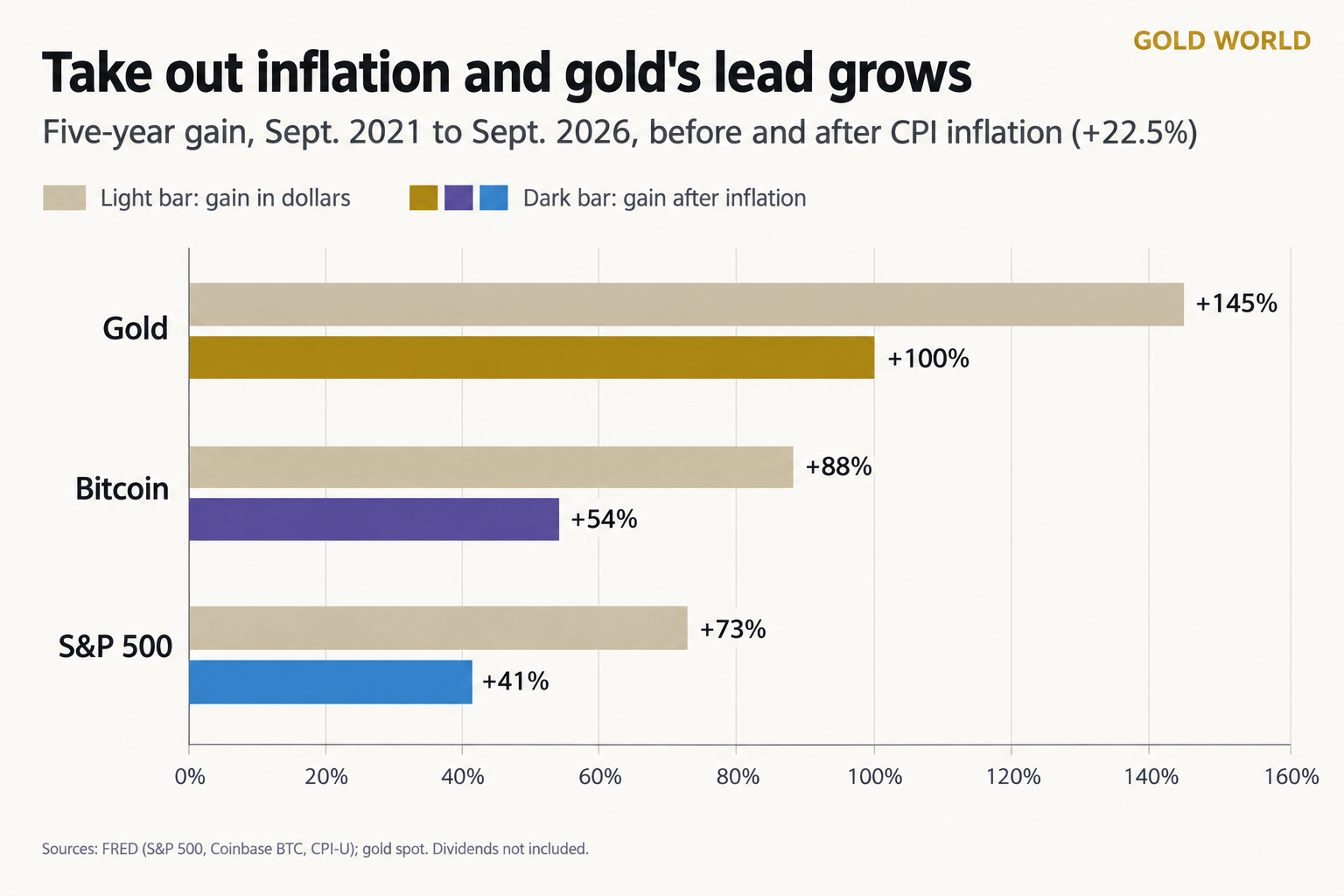
In plain English, nearly a third of the stock market’s five-year “gain” was just the dollar losing value. Part of that climb was the ruler shrinking…
Gold measures that shrinkage better than anything else on the board. That’s what money does.
Price Everything in Ounces
I like to run one more test, because it cuts through all the noise about nominal highs.
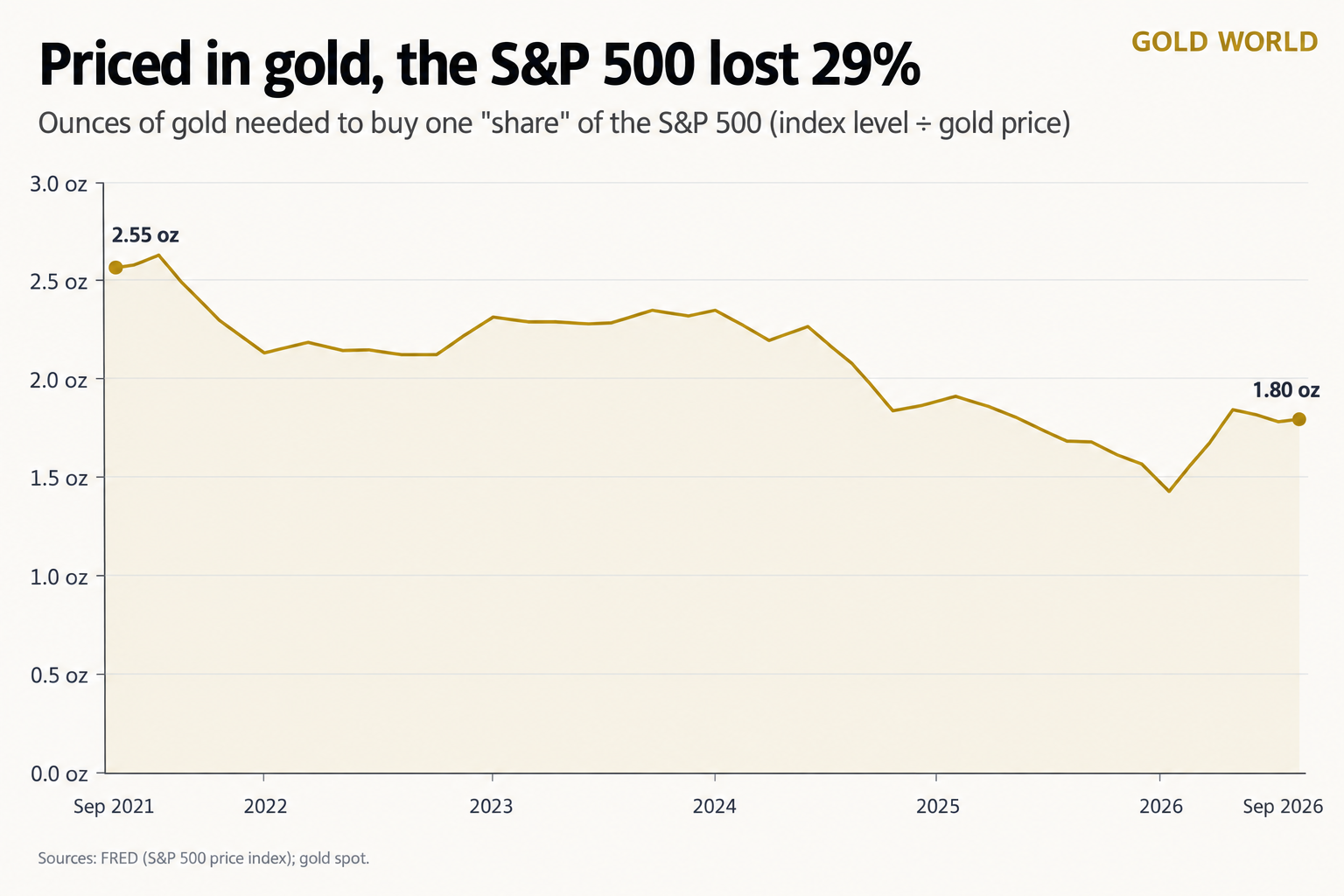
Forget dollars. Price the S&P 500 in gold.
Five years ago, one “share” of the S&P 500 (the index level divided by the gold price) cost you 2.55 ounces of gold. Today it costs 1.80 ounces.
That’s a 29% decline.
Let that sit for a second. The Nasdaq closed at a record 27,244 on Tuesday. The S&P has notched record after record this year. The headlines have been wall-to-wall euphoria about AI.
And measured in real money, the broad U.S. stock market has lost nearly 30% of its value in five years.
Bitcoin tells the same story. One bitcoin bought 25.7 ounces of gold in September 2021. It buys about 19.7 ounces today. The “digital gold” lost nearly a quarter of its value against the actual gold.
We’ve seen this movie before. From 2000 to 2011, the S&P went nowhere in dollars and lost about 85% of its value priced in gold. Everybody was staring at the dollar chart the whole time, wondering why they felt poorer.
The Ride Matters as Much as the Destination
Returns are one thing. Whether you could actually stomach them is another.
Bitcoin hit nearly $69,000 intraday in November 2021, a few weeks after our starting line. One year later, on November 21, 2022, it closed at $15,756. That’s a 77% drawdown from peak. From our September starting point, you were down 65%.
Be honest with yourself. How many people who bought at $44,000 were still holding at $15,700? The ones who sold never collected that 88%.
The S&P peaked at 4,797 on January 3, 2022, then slid 25% to 3,577 by October. Painful, but survivable.
Gold had rough patches too, and I won’t pretend otherwise. It dipped into the low $1,600s in the fall of 2022. And after running past $5,300 in late January of this year, it’s pulled back roughly 20% to where it sits now.
But look at when that 2022 slump happened. The Fed was ripping rates higher at the fastest pace in four decades, the one environment every textbook says should crush gold. It bent. It didn’t break. And it came out the other side of that hiking cycle to set record after record.
Why Gold Won
This wasn’t luck. There’s a mechanism, and it’s worth understanding because it’s still running.
Think about what happened in February 2022. The U.S. and its allies froze roughly $300 billion of Russia’s central bank reserves. Overnight, every finance ministry outside the West learned that dollar reserves held in Western accounts belong to you only as long as Washington approves of you.
The response was immediate. Central banks bought more than 1,000 tonnes of gold in 2022, according to the World Gold Council. Then they did it again in 2023. Then again in 2024. Three straight years above 1,000 tonnes, roughly double the pace of the decade before.
The People’s Bank of China has now added gold for 22 straight months through August. Poland pushed its reserves to 648 tonnes. These buyers don’t care about the quarterly chart. They’re building balance sheets meant to last decades, and they want an asset with no counterparty and no foreign kill switch.
That’s a floor under the gold price that bitcoin and the S&P simply don’t have.
Meanwhile, the other side of the ledger kept getting worse. Washington’s interest bill on its debt now tops $1 trillion a year. The 10-year Treasury pushed above 5% this month. And on September 16, the Fed raised rates to a 3.75% to 4.00% range, with 16 of 18 officials penciling in at least one more hike.
Every hike makes the government’s interest bill bigger. Every bigger bill makes the eventual monetary bailout more likely. Gold is pricing where this ends up…
What the Crowd Still Doesn’t See
Here’s what gets me.
Even after five years of this, most American investors own essentially zero gold. The standard 60/40 portfolio your advisor built doesn’t have a line for it. Financial media still treats gold as a fear trade for guys with bunkers, and bitcoin as the young, smart alternative.
The scoreboard says the opposite. The “boring” asset beat the exciting one and the consensus one, in nominal terms, in real terms, and on a risk-adjusted basis. It did it with a fraction of bitcoin’s volatility and with sovereign buyers standing underneath the bid.
If you’ve been holding physical metal through all of this, you’re not the paranoid one. You’re the one who read the situation correctly.
That doesn’t mean you need to dump your stocks or torch your bitcoin. But know what job each one does. Bitcoin is a speculation on liquidity, and it’s a volatile one. Stocks are a claim on corporate earnings, priced in a currency that loses value every year. Gold is the thing you measure the other two against.
And make sure a real portion of it is physical. Coins and bars in your possession or in allocated storage. If you can’t hold it, you’re trusting someone else’s promise, and the last five years were one long lesson in what those promises are worth.
Where I’m Looking Next
Boring can be beautiful. Gold just proved it over five years.
I’m applying that same idea to the AI trade everybody’s chasing right now. The headlines are all about the chipmakers and the model builders, the bitcoin of this cycle. I’ve found a company doing something much less glamorous that the whole buildout can’t function without. It’s the gold of the AI boom, and almost nobody is talking about it.
I call it “The Most Boring Company in the AI Buildout,” and I’ve laid out the full case for members of The Wealth Advisory. Click here to see why I think it’s one of the best ways to profit from AI without paying bubble prices.
Five years ago, the crowd went through Door No. 1 and Door No. 2.
The real money was behind Door No. 3 the whole time.
To owning what’s real,
Jason Williams
Senior Investment Strategist, Gold World